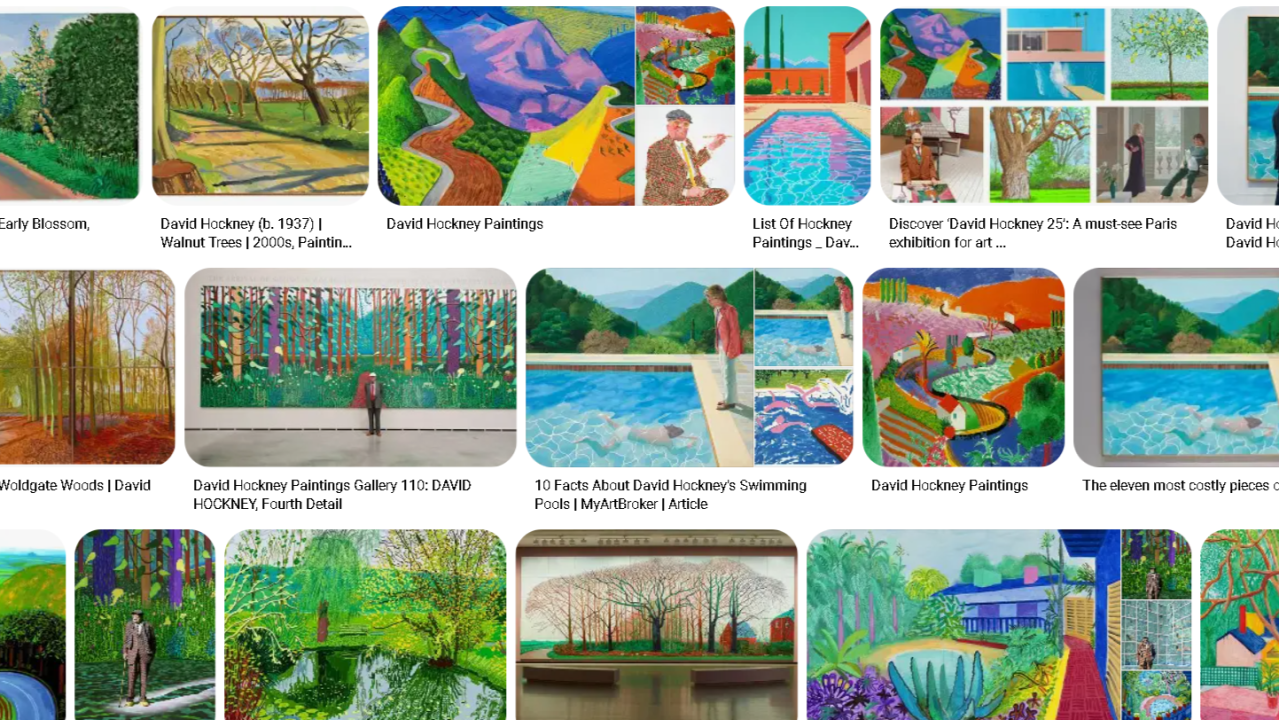
David Hockney died at home in Normandy on 11 June, a month shy of his 89th birthday. The man who taught us how California light falls on a swimming pool is gone, and the pools keep their colour anyway.
It is hard to think of an artist who refused stillness so completely. Born in working-class Bradford in 1937, he emerged from the edges of British Pop in the sixties, then found in Los Angeles the subject that made him famous: water, glass, sunlight, the flat blue rectangle of a pool holding a single splash. Portrait of an Artist (Pool with Two Figures) later sold for some £70 million. But the price was never the point. The looking was.
What stays with me is his restlessness. He painted gay intimacy in a Britain where it was still a crime. He returned to Yorkshire to paint its hedgerows, then to Normandy to paint its seasons—ninety metres of them, made on an iPad, because at eighty he had decided the tablet was simply a new brush. Few artists of his stature ever risked looking foolish. He did it gladly.
There is a lesson in that for anyone whose work is to carry meaning faithfully from one form into another. Hockney spent six decades translating—light into pigment, a Yorkshire lane into a screen, pleasure into something the rest of us could see. He never mistook the tool for the task.
“I want to work every day,” he said near the end. He very nearly did.
#Art #Hockney #Poolside #Stillness
No responses yet